




This background video contains only decorative imagery and does not convey meaningful information.

Featured Article
How to Navigate Election Anxiety & Support Your Mental Health Through Election Season

What is Phosphatidylcholine and How Can it Benefit Your Health?
What Are Vitamins and Why You May Need More Than Just a Multivitamin

Do Selenium Benefits Include Thyroid Health?

Everything You Need to Know About Folate for Pregnancy: Benefits, Differences, Deficiency, and Sources

Mold Uncovered: How to Protect Yourself From Mold in Your Food and Home
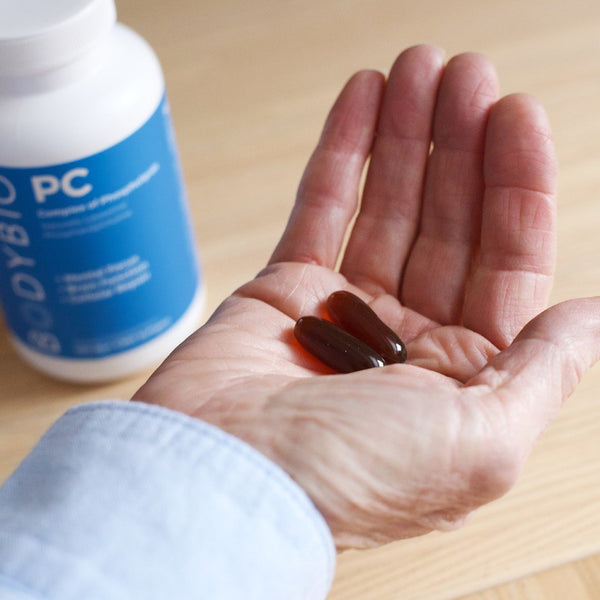
Could Phosphatidylcholine (PC) be the key to a sharp memory?
Key Takeaways:
- The deterioration of cell membranes can be attributed to memory loss
- PC has been shown to support a healthy cell membrane, and in turn better brain functioning as we age*
- PC serves as a reservoir for the choline needed to make the neurotransmitter Acetylcholine
Some captivating movies have been made about people whose memory loss takes them on curious meanderings. These episodes of amnesia, usually the result of some kind of physical, emotional or psychological trauma, are short-lived on the silver screen and almost always resolve themselves to a sigh of relief. In real life, memory loss can range from a mere annoyance or a serious impediment. Occasional forgetfulness, such as entering a room and wondering why you went there or misplacing your car keys for the second time today, becomes increasingly common with age. In most cases, that’s no cause for alarm, at least not unless it interferes with everyday activities.
Memory loss can be caused by a litany of triggers. Medications, including antidepressants, antihistamines, anti-anxiety medications, muscle relaxants, tranquilizers and pain medicines are a major cause of memory debilitation. Alcohol and drugs do the same, as may tobacco, which reduces the amount of oxygen that gets to the brain. Sleep deprivation, depression, stroke, head injury, and nutritional deficiency affect memory as well. The hormone imbalances that plague women near and at menopause wreak havoc on memory function in varying degrees. If you find that you are increasingly forgetful, you might want to talk with your doctor to determine the cause. Then you can pursue a line of treatment if one is deemed necessary. The efficacy of different treatments available will surprise you.
Diseases and Memory Loss
The two kinds of serious memory fault that people face are Alzheimer’s disease and vascular dementia, the latter distinguished from the former by sudden onset instigated by small strokes or changes in blood supply to the brain. In the former, memory loss begins slowly and worsens over time. Prevention, interruption of disease progress, and treatment are legitimate topics of discussion within the medical community.
Hippocampus and Memory Loss
Besides being a mythological creature with a horse’s front hooves and the tail of a fish, the hippocampus is a major component of the brain that plays a vital role in the formation of memories, particularly moving them from short-term to long-term. It also serves as a guide for spatial memory, which is responsible for realizing one’s whereabouts and the relationship to them. Learning, reasoning and comprehension develop from this point and work to process information gathered by the senses. The decline in memory associated with hippocampus dereliction accounts for the inability to retain newly acquired data.
The Source of Memory Degradation
Ever wonder why it seems Grandpa can only talk about the past? One condition that helps to explain this is the deterioration of cellular membranes—in this case, those of the neurons. If phosphatidylcholine (PC), the major structural and functional phospholipid of a cell membrane, is absent or in meager supply, noticeable memory shortfall will appear (Crespo, 2004)*. Long-term, sustained use of a PC supplement helps to prevent memory deficits that accompany old age (Teather, 2006)*.
How Does Phosphatidylcholine Help Memory?
PC can also have a positive effect on some of the mechanisms involved in the manufacture of acetylcholine (a chemical found throughout the nervous system). Acetylcholine is liberated at nerve endings as a neurotransmitter, wherein it sends messages from one nerve cell to another and plays a prominent role in nervous system function by enhancing sensory perception. Alzheimer’s disease involves damage to the cells in the brain that manufacture acetylcholine. The damage to these all important cells also affects the manner of electrical movement across the synapse. Thus it influences the stages of memory function—encoding (making) of a memory, creation of a long-term memory from a short-term memory (consolidation), and recall (retrieval) of a memory. Acetylcholine has a more profound effect on encoding than on the other two actions. PC serves as a reservoir for the choline needed to make the neurotransmitter, so it doesn’t go directly to its manufacture. Instead, it goes directly to the maintenance and support of the cell membrane, thereby allowing the free travel of nutrients and energy into the cell and the passage of waste and debris out.
Not all PC (Phosphatidylcholine) is Created Equal
PC may be extracted from egg yolks, but that contains an overload of saturated fat that encourages rancidity. Commercial PC comes from soybeans instead. However, very few true phospholipid PC products are available. Most commercial phosphatidylcholine products consist of triple lecithin, getting the pseudo-PC designation because it contains PC as a major constituent, but at a fraction of the amount in true phosphatidylcholine. The remaining fraction includes ancillary fats and impedimentary nutrients that stop the authentic phospholipid from traveling past the digestive system. It never reaches the cell membranes and hence defeats the entire purpose of taking PC. True phospholipid PC maintains its integrity as a liposome, allowing it to reach and take up residence in the cell membrane and therefore improve memory.
If you need further proof of the efficacy of PC, deficiencies as early as utero can lead to lifelong cognitive deficiencies. The bottom line of PC intake entails DNA methylation, gene expression and changes in stem cell proliferation and differentiation (Zeisel, 2006)*. Hippocampus development appears to depend on it*.
If supplementation for cerebral support is in the near future, we need to understand choline is not the same thing as phosphatidylcholine. Though held to be a required nutrient, choline, whether from an animal source, from greens, or otherwise, has been implicated in cardiovascular issues. It is not a phospholipid and cannot restore, support and maintain the cell membrane, whose orderly function animates the whole person.

MCT Oil - Game Changer or an Oil Spill of Hype?
The media blast on MCT oil is mind boggling. You see it poured into coffee, added to smoothies, mixed into oatmeal. We are told that MCT’s suppress hunger, increase energy and boost mental clarity. Sound too good to be true? Let’s take a closer look at the impact of loading MCT’s into your diet.
Just the Facts on MCT
Medium-chain triglycerides (MCTs) are fat molecules with 3 saturated fats attached to a glycerol backbone. MCTs contain between 6 and 12 carbons in their fatty acid chain and are commonly found in coconut oil, palm kernel oil and dairy products. The main MCTs are caproic, caprylic, capric and lauric acids. Coconut oil has the greatest percentage of these, at >60%, followed by palm kernel oil at >50%, and dairy with only about 10%. Straight MCT oil has a higher concentration of the shorter-chain fats that are more efficiently converted to ketones, with caprylic in the lead. Standard MCT’s are liquid at room temperature, while coconut oil is usually solid or semi-solid.
MCTs serve us exclusively with energy and calories; they do not contain essential fatty acids nor are they bioactive lipids. MCTs are broken down and absorbed rapidly, going straight to the liver, where they can be used as instant energy sources or turned into ketones, which can cross to the brain and supplant the carbohydrates/glucose that are normally used for fuel. Additionally, the calories in MCTs are so efficiently utilized that they are less apt to be stored as fat.
Scientific Deep Dive
A shot of MCT oil can give rise to ketone manufacture in liver cells, even when there is ample glycogen availability. This occurs because medium-chain fatty acids can stream into mitochondria in the liver efficiently and get converted either to ketone bodies or to carbon dioxide. The half-life of medium-chain fatty acids is such that they demonstrate a high oxidative metabolism and trigger thermogenesis, reducing the potential for weight gain.
The Ketogenic Diet, a very high fat diet, has been used to help control seizure activity since the 1920s, prior to the development of anticonvulsant drugs. However, when children did not respond to medications and developed ‘intractable’ seizures, the classic therapeutic ketogenic diet (90% fat) was introduced in a clinical setting at Johns Hopkins. In the mid-1990s, when a movie producer’s son responded to the extreme ketogenic diet, the concept became more popular, and eventually more moderate approaches were used, such as the ‘Modified Ketogenic Diet’. Since that time, thousands of medical papers have emerged on the subject to attempt to create a ‘ketogenic pill’.
More currently, MCTs have been reported to enhance memory in mild cognitive impairment (Krikorian, 2012) (Veech, 2004). These observations, then, support rationale for a ketone fuel replacement. However, medical diets attempting to use MCT oil exclusively for seizures failed and they had to go back to the drawing board.
MCTs are unlikely to exacerbate obesity; they do not give rise to ectopic fat metabolites that mediate metabolic syndrome; and they have little adverse impact on serum lipid profiles, despite an increase in total cholesterol.
The idea behind adding MCT’s to your coffee is that it converts the human body into a fat-burning instrument, thus promoting healthy weight loss and eliminating hunger pangs. Proponents argue that this is because the MCT oil in coffee turns to ketones instantly and boosts your metabolic rate.
Energy from MCT is more readily available than from butter or other fats or oils (saturated, unsaturated, monounsaturated). Furthermore, MCT does not require bile (released from the gall bladder), as other fats do, to be digested. So for those who struggle with fat intolerance, MCT oil is easier for the body to use as a source of calories, energy and satiety.
On the Down Side
MCTs are nothing more than a storehouse of calories and coincident energy. They do not, and cannot, support cellular health because they lack essential fatty acids, making them non-bioactive lipids. Overwhelming the system with a surge of MCTs is apt to cause diarrhea, nausea and vomiting.
Though it is possible to obtain MCT oil from coconuts, it is more likely derived from less costly palm oil or palm kernel oil, thereby raising harmful levels of palmitic acid. It is prudent to proceed with caution, as this ingredient that is contained in some processed foods and the fat calories that are touted as grandly “healthy fat” may return to haunt you. Palmitic acid is the fuel that stimulates macrophages, white blood cells that drive inflammation.
Here’s a shocker: To control palmitic acid, increase the omega-6 linoleic acid in the diet*. BodyBio Evening Primrose Oil and BodyBio Safflower Oil are reliable sources.
What About Increased Energy? Brain Function?
MCT in your coffee is supposed to increase focus and eradicate brain fog—seems like an awful lot of pressure for one cup to contain. The claim is that the addition of butter to the coffee slows caffeine absorption, effectively micro-dosing the caffeine’s effects throughout the day, making you less jittery and more focused.
The routine of eating fat in your coffee, even grass-fed Kerry Gold, and more fat from palm kernel oil, doesn’t arouse passion in many people. Breakfast without protein? Nah! Studies to support this behavior are rarely seen, if at all. Any weight lost through this regimen is apt to return with a vengeance. What’s more, the saturated fat in this recipe exceeds 24 grams, equaling 120% of the daily recommended amount for a woman and 80% of that for a man. (Percentages will vary according to the tables used.)
You can lose weight on any fad diet, however, it’s a change in lifestyle that makes a lasting difference. That means making healthy choices such as eating balanced meals, consuming pure, balanced essential fatty acids, exercising regularly, and yes, even the occasional cup of *regular* coffee.